There's gotta be a book in this...
SPIRITS LOW? COME IN FOR A FAITH LIFT!
22 June 2006
Sloganeering for Jesus
Sign out front of Epworth Methodist, on the way to Speech class:


13 June 2006
People-watching at the Star City Diner
I didn't ask to be princess, but the crown fits.And we wonder why they hate our freedoms.
— T-shirt on a 9-year-old a couple tables away at breakfast.
23 May 2006
Street scene, Bethlehem
I heard the bawling baby approaching first, a young infant with a good set of lungs, then it passed beneath my deck overhanging Prospect Ave, at last revealed in a 3-wheel racing stroller pushed by its jogging father, who patted behind at a fair clip, hydrator sloshing at his hip, Borg phone clipped to his near ear, free hand leashed to 2 trotting spaniels.
My dear, the gear...
My dear, the gear...
09 May 2006
Max Weber's definition of government
Government is an organization claiming a monopoly on the licit first use of force in a specified geographic region.
— paraphrased in Eric S. Raymond's "Why I Am an Anarchist"
15 April 2006
"Boys" on Verse Daily
It's a small thing, but good news is always welcome. My poem "Boys," recently published in Runes: Signals, was featured April 2 on the poetry site Verse Daily.
Thanks to CB ('Lyn) Follett & Susan Terris, co-editors of RUNES, for the heads-up — and always for their encouragement & enthusiasm.
09 April 2006
Life at work
Life at work is like a tree full of monkeys, all on different limbs at different levels.
Some monkeys are climbing up, some down.
The monkeys on top look down and see a tree full of smiling faces.
The monkeys on the bottom look up and see nothing but assholes.
— sign on the door of 19 Old Main, Kutztown U
03 November 2005
Pilgrim's Progress
I was driven out of my native country by a dreadful sound that was in mine ears, to wit, that unavoidable destruction did attend me, if I abode in that place where I was.
— Bunyan, Pilgrim's Progress
03 October 2005
Heuristic
Staten Island
Across the street, a pregnant mother & her 2-year-old daughter (son? the hair's short & silky) make their slow way up the sidewalk in front of Roberta's house, each pushing a fold-up stroller, one child-sized, one doll-sized. The mom's wearing dark blue overalls w/ white polka dots cross-tied over her shoulders, the toddler a pink hooded sweatshirt over pink jeans — her stroller's pink, too, just like her mother's is dark blue [mom also wears a red back pack just under her longish brown pony tail]. Right at Roberta's gate there's a raised seam in the sidewalk & the little one gets stuck, but the mom just stops & waits, murmuring encouragement until the little one works it out. Then they're on their way.
Across the street, a pregnant mother & her 2-year-old daughter (son? the hair's short & silky) make their slow way up the sidewalk in front of Roberta's house, each pushing a fold-up stroller, one child-sized, one doll-sized. The mom's wearing dark blue overalls w/ white polka dots cross-tied over her shoulders, the toddler a pink hooded sweatshirt over pink jeans — her stroller's pink, too, just like her mother's is dark blue [mom also wears a red back pack just under her longish brown pony tail]. Right at Roberta's gate there's a raised seam in the sidewalk & the little one gets stuck, but the mom just stops & waits, murmuring encouragement until the little one works it out. Then they're on their way.
16 September 2005
Family Happiness
On our first date, I told my wife
I was a lesbian trapped in the body of a man.
Everybody says that now, of course,
on TV and radio, alternativev media outlets,
tattoos and bumper stickers, but this was long ago, when
none but the brave (who deserve the fair)
would come up with somethiong like that.
She smiled the pleased and goofy smile that flowers in her big eyes,
and I thought I had her.
Looking back now, though,
I can see her appraisal of me rounding to completeness.
I can hear her cognition firing.
She knew it. She knew even then
the truth it has cost me aeons to acquire,
climbing and climbing the broken stairs:
I'm a man trapped in the body of a man.
I clutch the smooth walls and see through his eyes
the oil fires and containment units,
the huge clawed gantries strung out on the twilit polar horizon.
Through his alloyed ears, I hear
the objects of his scorn, his compassion, his hatred, his love
crying out and crying out.
Half my arms are his arms.
Half my face is welded to his face.
The other half mouths his clumsy ironies.
"Life is war," he says.
"Tragic," he says. "Tragic."
The simulacra are marching everywhere,
and deep in the caves the chimera are breathing.
— Vijay Seshadri, in New Yorker August 29, 2005, 72.
14 September 2005
This is no time to tire!
"Up on your feet! This is no time to tire!"
My Master cried. "The man who lies asleep
Will never waken fame, and his desire
and all his life drift past him like a dream,
and the traces of his memory fade from time
like smoke in air, or ripples on a stream.
Now, therefore, rise. Control your breath, and call
upon the strength of soul that wins all battles
unless it sink in the gross body's fall.
There is a longer ladder yet to climb:
this much is not enough. If you understand me,
show that you mean to profit from your time."
— Virgil to Dante, Inferno XXIV 46-57
10 September 2005
We fabulists live two lives at once
It is said that we fabulists live two lives at once. First we live as others do: seeking to feed and clothe ourselves, earn the respect and affection of our fellows, fly from danger, entertain and satiate ourselves of the things of this world. But then, too, we live a second life, pawing through the moments of the first, even as they happen, like a market-woman of the bazaar sifting trash for treasures. Every agony we endure, we also hold to the light with great excitement, expecting it will be of use; every simple joy, we regard with a critical eye, wondering how it could be changed, honed, tightened, to fit inside a fable's walls.
— Benjamin Rosenbaum, "Notes to A Discourse on the Nature of Causality," fictionwise.com, 53. An Alternate History, like The Difference Engine.
Good listener
Spudfest tale:
People accuse me of not being a good listener, but I just know what they're going to say.
— some Brahmin my friend Bruce used to work for.
09 September 2005
Shreds & Patches Gather No Moss
About a month ago, I responded to a call in the Chronicle of Higher Education for submissions by "graduate students, faculty members, and administrators who will be on the job market in the 2005-6 academic year and would be interested in keeping a diary of their job search."
Yesterday I got the reject slip, so there's no need to keep it under wraps any longer. Its original title was "A Thing of Shreds & Patches," with the alternative title "Gathering No Moss." Submittants were permitted to use a pseudonym to protect their tenuous hold on current employment; I chose Nestor Didaskalos, for reasons which the following may make clear.
Without further ado, have at it.
A Thing of Shreds and Patches
(alternate title: Gathering No Moss)
by Nestor Didaskalos
I've been an irregular in academe for over thirty years. The first fifteen were spent in tenure-track positions that didn't pan out; since then I've lived the gypsy's life of perpetual adjunct instructor and part-time administrator, at institutions ranging from large urban universities to a tiny rural community college. For much of that time, I've been more or less content with my lot, because in the beginning I told myself that I was only doing this college stuff to support my habit of writing (poetry, plays, fiction, hypertext), and then I found I had the knack for it and enjoyed the work, and eventually got good enough to think I could maybe make a living as a professor, and so I have, after a fashion.
But recently the grasshopper's perspective on getting and spending has grown pretty tired, not to mention nearly suicidal in today's economy, and I've begun to adopt the ant's industrious and systematic approach. In short, admittedly late in the game, I find myself in the market for a full-time job.
Like most academic nomads, I've had to turn my hand to many different tasks along the way -- student counseling, curriculum development, program directing, publications, communication design, faculty training, tech support, online course development, and -- oh yeah, teaching: dramatic literature and theatre history, writing of all kinds (from stage plays to electron lit), all manner of interdisciplinary studies, and, most recently, in an ironic plot twist no fictioneer could ever get away with, speech communication, the only course I ever failed in college (well, it *was* 1968...).
At the moment I'm going after positions in instructional technology, in part because I love playing with the toys, but also because I really like helping people figure out how things work -- it's the master motif in every one of my lectures, for example -- and one of the most challenging problems in most of our lives today is persuading all our devices to cooperate so we can get our work done. My dream job would be one in which I'd often get the chance to say, Sure, I can help you with that.
I just got back from a two-day conference of people who hold down such jobs as I'm applying for, and a jolly time it was indeed. Some of them teach, some write books, some run stables of other techies, some are the only one of their kind at the school they serve. But all are finding new ways to look at the world through technology, and, in a practical way, explore the media environment that claims more and more of our time and attention day by day. After the plenaries and workshops on each day of the conference, we all repaired to the local watering hole to tell tall tales, share war stories, and occasionally find a solution to a problem -- conceptual, professional, even personal.
With ant-like focus on my objective, I did the networking thing, trying not to act desperate while also letting folks know I was in the market for a job like theirs. I hate this part.
In later installments of this diary, I'll no doubt relate much of the saga whose ever-unfolding plot has landed me in my present uncertain situation, but I believe I'll dedicate this episode to an account of the first lesson I learned about having an academic career, maybe any career: things change, and you need to find out whether you're willing to change with them, or should follow your bliss somewhere else.
A dramarama in college, I'd gone to grad school to make plays, not write papers on literary theory or research theatre history, though of course I was resigned to having to jump some academic hurdles to get my MFA, at that time a terminal degree. This I did without stealing too much time from writing my scripts.
If there was a job *market* when I first started working in higher ed, I didn't know about it. My first offer came about almost by accident: I'd dropped in to the Assistant Dean's office at the first school I visited -- with no application, no inquiry, no resume in hand, and no idea if there was even an opening there -- and it just happened that the fire escape from her office led right across the roof to the fire escape of the office that a brand new drama department was temporarily inhabiting. The Dean herself walked me across to make sure I didn't get lost. It was a different world then.
This brand new drama department had a killer business plan. There already existed a conservatory-type theatre program at the university, with a student-faculty ratio of about five to one. The new department took in the rejects from this conservatory program and farmed them out to professional training schools throughout the city, then brokered the rest of their BFA requirements through the university's Arts and Sciences college. Technically, no instructors were actually needed here, though the Dean at least tried to make it look like a regular department, by letting our chairman teach a course or two, and by hiring me.
My first year, we had maybe 125 students, all freshmen and sophomores (the conservatory program had only 50 in all four years). By the time I lost a tenure run-off ten years later (to a colleague I'd helped bring on board, of course), the enrollment was nearly 1000; today it's close to 1500, and the number of faculty (I was #2, after the chair) is nosing into three digits.
When I later read accounts of life in start-up software companies in the early days of the dot-com bubble, I was immediately in familiar territory: the long hours, the staggering amount of work, the certainty that we were changing the world, the unquestioned loyalty towards each other, the overall sense of *mission* -- it felt like the Wild West, and we were building the New Jerusalem.
Sounds terribly self-important, I know, but only from a perspective outside that heady, adrenaline-drenched state of mind that makes boot-strapping any something-from-nothing enterprise possible.The rush beats the effect of any drug you can buy, because it comes from inside, and when the trip's over, you've got something to show for it, something lasting, something others can pick up and take even further.
Which is exactly what happened, duh. It wasn't really the Wild West, it was a university; we didn't build the New Jersalem, but a viable department in a school of that university. Sooner or later we had to stop acting like cowboys and start behaving like academics, to quit pulling new programs out of the ether and begin making the ones we'd already invented work better.
It turned out that I wasn't so good at this second-stage endeavor, perhaps because it was too safe, too normative -- too much like a small town, actually -- but also because my relative position in the new power structure was much more constrained: I couldn't just make up a course I felt like teaching, it had to be formally proposed, then passed on by curriculum committees, and finally approved by the Dean, a process that could take a year or more. (By contrast, the so-called "feeder school" where I now earn my crust turns such proposals around in a matter of months, sometimes weeks.)
I won't say I rejoiced in being denied tenure and promotion, but it did eventually present another opportunity at frontier-farming, as it were, and over and over again since that time I've gravitated toward situations where some pioneer has opened up a patch of wilderness that now needs a town built on it, and once again, to mix metaphors, I can turn my hand to whatever's needed to get wheels under the wagon so it can go.
The world of instructional technology has been around long enough that at many schools the transition from frontier town to provincial burg is well underway. At such venues I probably won't even get an interview, which is fine with me: I'd probably hate it pretty quick. Besides, in a few years they'll likely be blindsided by a new gizmo some eleven-year-old is right this moment dreaming up in his or her basement, whilst I sit here sweating the page breaks on my latest CV.
On the other hand, I learned a hell of a lot about the local terrain at that conference last week. We'll see what the human resourcers and officer types make of my checkered credentials.
28 June 2005
Media Ecology Unplugged
Last weekend the 6th Annual Convention of the Media Ecology Association was held at the Lincoln Center Campus of Fordham University, with the theme The Biases of Media. The MEA was founded in 2000 (it may have been earlier; the first convention was in June 2000) as an academic association "dedicated to promoting the study, research, criticism, and application of media ecology in educational, industry, political, civic, social, cultural, and artistic contexts, and the open exchange of ideas, information, and research among the Association’s members and the larger community" -- as it says on the media-ecology{dot}org home page. Among its founders was the late Neil Postman, who also supplied this definition: "Media ecology looks into the matter of how media of communication affect human perception, understanding, feeling, and value; and how our interaction with media facilitates or impedes our chances of survival."
The Moses of the MEA is Marshall McLuhan, who first proposed that media be regarded as an environment in order to understand its nature, its workings, and its effect upon our lives, and the study of environments is ecology. (Sorry, ye grammaticall prescriptivistes, but in this register the singular of media is mediA, not mediUM. The old definition of medium as means of information transport has been replaced in current usage by the term technology, as in print technology, broadcast technology, online technology. Media, as an environment, is a singular thing. Get over it.)
I think as much as his ideas and formulations, it is McLuhan's *sensibility* that informs the ethos of the MEA, or rather of its constituent members and fellow travelers. He was a maverick in the academic world, regarded by many colleagues and critics as a buffoon at worst and a paradoxer at best; his seminal publications were not academic papers and books but pop-art manifestos, broadsides, and talk-show appearances; his deepest immediate influence was on students in his classes, some of whom became apostles who spread the gospel so effectively that only 25 years after his death, there now exists a kind of church, the Media Ecology Association.
I won't pursue the early-church analogy here (I'm working on a paper), but only say that the enthusiasm, openness, sense of mission, and above all feeling of fellowship among the membership in attendance made for a heady weekend indeed.
The Convention actually sprawled across 5 days, Wednesday through Sunday, and comprised some 250 demos, panels, and presentations, with topics ranging from Bringing General Semantics-Based Media Literacy to Younger People to The Wiring of Bhutan: A Test Case for Media Ecology in the Non-Western World. There was, perhaps predictably, a session dedicated to blogging, entitled rather cryptically Media Bias and the Emerging Online Communities. The entire program is somewat awkwardly encased in a 20-page .pdf at the site if you want to browse through and see what you missed.
If you do check it out, you'll find on page 13 of 20 an item labeled Performance: Media Ecology Unplugged, presented by Bill Bly -- Fordham University and John McDaid -- New York University. And therein lies the tale of this entry.
I knew nothing of media ecology and had only heard of McLuhan (well, and seen him in Annie Hall) when John, who was then (as now) a Ph.D candidate in media ecology, proposed we do a joint presentation at the 1st annual Convention of the Media Ecology Association, at which he was presenting a paper and also I think sitting on a panel. Hardly a traditional academic, I'd only presented my first conference paper the previous fall, and so was appalled, until he said we should play our guitars and sing, the Simon and Garfunkel (or more likely, I thought, the Smothers Brothers) of media ecology. We did pretty well, on the applause meter at least, and have continued to lighten the load if not the path of the proceedings every year since (except the last, when neither of us could make it to Rochester). This may make the MEA the only academic organization to have a house band; if so, I'm not surprised -- it's that kinda gang.
After that first performance, John and I were sufficiently pumped that we decided to make a CD, Media Ecology Unplugged, which won the 2002 John Culkin Award for Outstanding Praxis in the Field of Media Ecology. We haven't sold enough copies to recoup recording expenses, but then I've been in charge of marketing, so that's no surprise. Nevertheless, you can sample our wares at infomonger{dot}com, and if you'd like a hand-burned copy with liner art output from my Epson ColorPhoto 820, drop me an E at bbly{at}infomonger{dot}com.
Let me just say a word of appreciation for Lance Strate, brilliant media theorist and historian, co-founder and president of MEA, former chair of Communication & Media Studies at Fordham (he hired me), fellow grad student with John at the New School, and all-around mensch. Without his encouragement (some might say indulgence) I wouldn't be here, nor have this wondrous tale to tell. Lance, you give me reason to live.
The Moses of the MEA is Marshall McLuhan, who first proposed that media be regarded as an environment in order to understand its nature, its workings, and its effect upon our lives, and the study of environments is ecology. (Sorry, ye grammaticall prescriptivistes, but in this register the singular of media is mediA, not mediUM. The old definition of medium as means of information transport has been replaced in current usage by the term technology, as in print technology, broadcast technology, online technology. Media, as an environment, is a singular thing. Get over it.)
I think as much as his ideas and formulations, it is McLuhan's *sensibility* that informs the ethos of the MEA, or rather of its constituent members and fellow travelers. He was a maverick in the academic world, regarded by many colleagues and critics as a buffoon at worst and a paradoxer at best; his seminal publications were not academic papers and books but pop-art manifestos, broadsides, and talk-show appearances; his deepest immediate influence was on students in his classes, some of whom became apostles who spread the gospel so effectively that only 25 years after his death, there now exists a kind of church, the Media Ecology Association.
I won't pursue the early-church analogy here (I'm working on a paper), but only say that the enthusiasm, openness, sense of mission, and above all feeling of fellowship among the membership in attendance made for a heady weekend indeed.
The Convention actually sprawled across 5 days, Wednesday through Sunday, and comprised some 250 demos, panels, and presentations, with topics ranging from Bringing General Semantics-Based Media Literacy to Younger People to The Wiring of Bhutan: A Test Case for Media Ecology in the Non-Western World. There was, perhaps predictably, a session dedicated to blogging, entitled rather cryptically Media Bias and the Emerging Online Communities. The entire program is somewat awkwardly encased in a 20-page .pdf at the site if you want to browse through and see what you missed.
If you do check it out, you'll find on page 13 of 20 an item labeled Performance: Media Ecology Unplugged, presented by Bill Bly -- Fordham University and John McDaid -- New York University. And therein lies the tale of this entry.
I knew nothing of media ecology and had only heard of McLuhan (well, and seen him in Annie Hall) when John, who was then (as now) a Ph.D candidate in media ecology, proposed we do a joint presentation at the 1st annual Convention of the Media Ecology Association, at which he was presenting a paper and also I think sitting on a panel. Hardly a traditional academic, I'd only presented my first conference paper the previous fall, and so was appalled, until he said we should play our guitars and sing, the Simon and Garfunkel (or more likely, I thought, the Smothers Brothers) of media ecology. We did pretty well, on the applause meter at least, and have continued to lighten the load if not the path of the proceedings every year since (except the last, when neither of us could make it to Rochester). This may make the MEA the only academic organization to have a house band; if so, I'm not surprised -- it's that kinda gang.
After that first performance, John and I were sufficiently pumped that we decided to make a CD, Media Ecology Unplugged, which won the 2002 John Culkin Award for Outstanding Praxis in the Field of Media Ecology. We haven't sold enough copies to recoup recording expenses, but then I've been in charge of marketing, so that's no surprise. Nevertheless, you can sample our wares at infomonger{dot}com, and if you'd like a hand-burned copy with liner art output from my Epson ColorPhoto 820, drop me an E at bbly{at}infomonger{dot}com.
Let me just say a word of appreciation for Lance Strate, brilliant media theorist and historian, co-founder and president of MEA, former chair of Communication & Media Studies at Fordham (he hired me), fellow grad student with John at the New School, and all-around mensch. Without his encouragement (some might say indulgence) I wouldn't be here, nor have this wondrous tale to tell. Lance, you give me reason to live.
12 June 2005
10 June 2005
What we could have been
If Britain's generals had been more enterprising, if the French had failed to supply vital military and financial assistance, George Washington, Thomas Jefferson, Alexander Hamilton and the rest would be known to us not as political & philosophical giants but as reckless (and hanged) losers, supporting players in a single act of Britain's imperial drama. We would all be Canadians now, with lower prescription drug costs and an inordinate fondness for winter sports.
— Barry Gewen, "Forget the Founding Fathers," New York Times Book Review, June 6, 2005, p.30.
05 June 2005
Pismo
My friend Emil has translated the entry about his talk/reading at the Bowery Poetry Club a couple weeks ago, and now I'm at published in Russian at Pismo.
It's a wonderful world...
It's a wonderful world...
28 May 2005
Mighty Haakon
I spend at least 8 hours a week on the road, scurrying from one freelance job to another: it's a gypsy's life. I ping-pong between Staten Island, NY, where I have a house, and Bethlehem, PA, where I have an apartment, with the occasional ricochet to Bucks County PA and Morristown NJ. And -- I almost forgot -- the Bronx, where I teach a class in Hypertext Theory and Practice at Fordham one night a week.
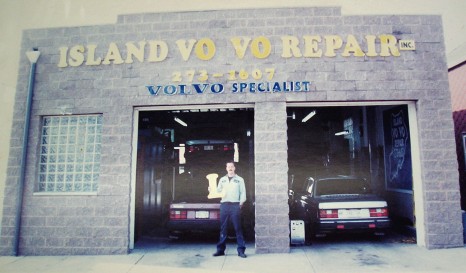
At highway speed through most of New Jersey, that's close to 500 miles a week, and over the 5 years I've been performing this boogie, I've put some serious mileage on Mighty Haakon the WonderVolvo, a dark blue 1991 240 sedan, maintained by our doughty neighbors Phil and Lee at Island Vo Vo Repair, 3 blocks away at 68 Hannah St. If you drive a Volvo and live anywhere within 100 miles of Staten Island, Island Vo Vo is the place to take your Big Swede next time for a periodical.
The name of the enterprise was Island Volvo for many years, until there was some kind of palace coup at Volvo Corporate, and the suits showed up on Phil's doorstep demanding he change the name, since he wasn't an official dealership. So Phil took out his stepladder, removed the "L" from the sign above the garage doors, and the suits had nothing more to say. There's a great photograph of him in front of the place, cradling the L in his arm, deadpanning the whole thing, as is his way.
I'm not sure how I got into this, but 6 years ago, there were only 60,000 miles on Mighty Haakon, only 50,000 more than when we bought him, used, in 1991. In another couple weeks or so, he'll turn 240,000. When I told my friend John McDaid this, he said, "That's as far as the moon." No other friend of mine would think of that.
When I thanked Phil for making it possible for me to drive to the moon, he said, "Which way you headed now?"
At highway speed through most of New Jersey, that's close to 500 miles a week, and over the 5 years I've been performing this boogie, I've put some serious mileage on Mighty Haakon the WonderVolvo, a dark blue 1991 240 sedan, maintained by our doughty neighbors Phil and Lee at Island Vo Vo Repair, 3 blocks away at 68 Hannah St. If you drive a Volvo and live anywhere within 100 miles of Staten Island, Island Vo Vo is the place to take your Big Swede next time for a periodical.
The name of the enterprise was Island Volvo for many years, until there was some kind of palace coup at Volvo Corporate, and the suits showed up on Phil's doorstep demanding he change the name, since he wasn't an official dealership. So Phil took out his stepladder, removed the "L" from the sign above the garage doors, and the suits had nothing more to say. There's a great photograph of him in front of the place, cradling the L in his arm, deadpanning the whole thing, as is his way.
I'm not sure how I got into this, but 6 years ago, there were only 60,000 miles on Mighty Haakon, only 50,000 more than when we bought him, used, in 1991. In another couple weeks or so, he'll turn 240,000. When I told my friend John McDaid this, he said, "That's as far as the moon." No other friend of mine would think of that.
When I thanked Phil for making it possible for me to drive to the moon, he said, "Which way you headed now?"
25 May 2005
Mazel tov, tovarisch Emil!
Three years back, during a too-short residency at the Vermont Studio Center, I became friends with Emil Draitser, a writer and professor of Russian literature at Hunter College. In 1974 (the year I started teaching) Emil was "blacklisted by the Soviet literary establishment for a satirical attack on one of its members, [and] immigrated to the U.S. where he continued his writing career," according to the bio on his website.
Last night I attended a talk and reading Emil gave at the Bowery Poetry Club, "Searching for Jewish Roots: An Evening of Russian-American Literature," sponsored by the Russian American Cultural Center. The occasion is the publication of Emil's new book, Kto ty takoi (Who Are You?), "a memoir of his childhood during the most perilous time of post-WWII Soviet history, and of the pressure of growing up Jewish in an anti-Semitic and totalitarian society." Here's the press release for the reading (Emil doesn't look quite so out of focus in person).
The talk was conducted in English, the reading in Russian. Emil told of coming to realize that a whole dimension of his childhood had somehow become lost to him: he was being interviewed about growing up Jewish in post-war Stalinist Russia, when his voice started to break, even though he wasn't particularly upset at that moment, but it felt, he said, "as if I was swallowing tears." His interlocutor recognized what was happening, saying that many of the people interviewed simply broke down sobbing, unexpectedly, once they started talking about their lives.
Arthur Miller describes a moment in the Witch Museum of Salem MA in 1951 or so, where he'd gone to do some research (for a new play that would become The Crucible), when a family of tourists came in, asking to see the nails -- i.e., those reportedly found in the flesh of the little girls who said they had been "witched" by one of their elders. He said, "I have an overwhelming urge to tell these people what the nails mean. It is the urge to write." (My paraphrase.)
Emil felt the same urge, only it was himself he needed to tell this story to -- and he was afraid he couldn't remember what happened, after so much time. But he found, he said, that we remember everything: memories are like index cards -- they might get pushed back into corners or buried under others, but all you have to do is take one away and then another, and eventually it all comes back.
The novel-in-progress is about Jewish emigration from the Soviet Union, and the part Emil read is set in Rome, where he spent a month and a half in the Russian community there while his papers were being processed for his eventual "repatriation" to America. Unfortunately, he told us before starting to read, "I write my academic books in English, because they come from the head. But my fiction comes from the heart, and so I write in Russian." He apologized to those of us who wouldn't know what he was saying, but I loved watching my friend work the audience -- who found the story hilarious -- without being encumbered by the meaning of his words.
I left much edified -- about memory, about writing, about life.
Last night I attended a talk and reading Emil gave at the Bowery Poetry Club, "Searching for Jewish Roots: An Evening of Russian-American Literature," sponsored by the Russian American Cultural Center. The occasion is the publication of Emil's new book, Kto ty takoi (Who Are You?), "a memoir of his childhood during the most perilous time of post-WWII Soviet history, and of the pressure of growing up Jewish in an anti-Semitic and totalitarian society." Here's the press release for the reading (Emil doesn't look quite so out of focus in person).
The talk was conducted in English, the reading in Russian. Emil told of coming to realize that a whole dimension of his childhood had somehow become lost to him: he was being interviewed about growing up Jewish in post-war Stalinist Russia, when his voice started to break, even though he wasn't particularly upset at that moment, but it felt, he said, "as if I was swallowing tears." His interlocutor recognized what was happening, saying that many of the people interviewed simply broke down sobbing, unexpectedly, once they started talking about their lives.
Arthur Miller describes a moment in the Witch Museum of Salem MA in 1951 or so, where he'd gone to do some research (for a new play that would become The Crucible), when a family of tourists came in, asking to see the nails -- i.e., those reportedly found in the flesh of the little girls who said they had been "witched" by one of their elders. He said, "I have an overwhelming urge to tell these people what the nails mean. It is the urge to write." (My paraphrase.)
Emil felt the same urge, only it was himself he needed to tell this story to -- and he was afraid he couldn't remember what happened, after so much time. But he found, he said, that we remember everything: memories are like index cards -- they might get pushed back into corners or buried under others, but all you have to do is take one away and then another, and eventually it all comes back.
The novel-in-progress is about Jewish emigration from the Soviet Union, and the part Emil read is set in Rome, where he spent a month and a half in the Russian community there while his papers were being processed for his eventual "repatriation" to America. Unfortunately, he told us before starting to read, "I write my academic books in English, because they come from the head. But my fiction comes from the heart, and so I write in Russian." He apologized to those of us who wouldn't know what he was saying, but I loved watching my friend work the audience -- who found the story hilarious -- without being encumbered by the meaning of his words.
I left much edified -- about memory, about writing, about life.
08 May 2005
Two Kinds of People...
As everyone knows, there are two kinds of people in the world: those who think there are two kinds of people in the world, and those who don't.
Being one of the first kind of people has certain advantages: for example, you're able to account for things some people do that is otherwise inexplicable, such as re-electing George W. Bush. If you believe there's only one kind of people in the world, you'd have to think that 51% of them had become psychotic, or had been replaced by eidolai that came out of giant bean-pods in the garage, or had suffered some other incredible mishap that, if you took it seriously, would make you doubt your own grip on reality.
When my daughter Nelly started to ask all those questions that start with W, my favorite was "Daddy, what makes them do that?" -- because it was the only one I felt I could honestly get away with answering, "I really don't know. I've never been able to figure that one out." I didn't have the heart to tell her there are two kinds of people in the world, at least until she was old enough to have some compassion, understanding, and respect for such poor benighted souls following their leader (whoever he happened to be) into the darkness: they can't help themselves, sweetie-heart, because they are, well, different from us.
At a political luncheon on that fatal election day last fall, I heard a dear friend and fellow traveler describe the dichotomy thus: "What we (liberals) want is a big tent, and for everybody to be able to get into the process; all they (the conservatives) want is 51%, and they're willing to do anything to get it."
It may seem at first glance that my friend is with me, believing that there are two kinds of people -- liberals and conservatives, in this formulation -- liberals recognizing and respecting difference, hence their open-door policy; while conservatives only see things one way -- their way.
But in fact it's the other way round: liberals believe that all people are created equal, and therefore are entitled to every protection the law can provide; conservatives recognize clearly that there are two kinds of people -- the good ones (them) and the evil spawn of the devil (us) who must be exterminated by any means necessary.
Well, maybe each group has both kind of people in it, which might account for Jim Wallis's encouraging book God's Politics: Why the Right Gets It Wrong and the Left Doesn't Get It as well as Dennis Miller's going over to the Dark Side.
Bernard Shaw, in his seminal modernist rant The Quintessence of Ibsenism, divvies up the world's population into Idealists and Realists (well, actually there are also the Philistines, but they count for little, since they're able to get along pretty much with things as they are). It would be tempting to think, at least among the combatants strutting and fretting their hour upon politco-cultural stage today, that the liberals are the realists, trying to get government to mirror the world as it is -- i.e., full of all different kinds of folk, including not only fat rich straight white ones, but also people of all different colors, races, creeds, genders, sexual orientations, and body weight -- while the conservatives are the idealists, trying to force everybody to force everybody to actually be all the same -- i.e., aligned with the Lord and imbued with Fambly Vayooze.
Again, at least to this two-kinder, that's backwards. Liberals believe that government can actually evolve (with help, admittedly) into the Peacable Kingdom, whereas conservatives *know* that the only thing government is really good at is preventing some people from doing what they want (albeit, sometimes, to the benefit of all concerned). Who was it who brought the term realpolitik into our national discourse? Wasn't it Henry the K (may the vultures roost on his shoulders)?
I think the only way to make any sense of this controversy is to get Biblical on its ass.
That pretty much sums it up for me, how about you? The thought has occurred that this might be an evolutionary thing, possibly even DNA-related (as was clearly the case between the woman and the serpent), and that the survivor in the culture wars was going to be the one with the passionate intensity, irrespective of position on the issues.
Does being a big-tentist preclude being a realist? I sure hope not, but Team Liberal better find itself a firebrand somewhere and soon, cuz night is falling fast.
Being one of the first kind of people has certain advantages: for example, you're able to account for things some people do that is otherwise inexplicable, such as re-electing George W. Bush. If you believe there's only one kind of people in the world, you'd have to think that 51% of them had become psychotic, or had been replaced by eidolai that came out of giant bean-pods in the garage, or had suffered some other incredible mishap that, if you took it seriously, would make you doubt your own grip on reality.
When my daughter Nelly started to ask all those questions that start with W, my favorite was "Daddy, what makes them do that?" -- because it was the only one I felt I could honestly get away with answering, "I really don't know. I've never been able to figure that one out." I didn't have the heart to tell her there are two kinds of people in the world, at least until she was old enough to have some compassion, understanding, and respect for such poor benighted souls following their leader (whoever he happened to be) into the darkness: they can't help themselves, sweetie-heart, because they are, well, different from us.
At a political luncheon on that fatal election day last fall, I heard a dear friend and fellow traveler describe the dichotomy thus: "What we (liberals) want is a big tent, and for everybody to be able to get into the process; all they (the conservatives) want is 51%, and they're willing to do anything to get it."
It may seem at first glance that my friend is with me, believing that there are two kinds of people -- liberals and conservatives, in this formulation -- liberals recognizing and respecting difference, hence their open-door policy; while conservatives only see things one way -- their way.
But in fact it's the other way round: liberals believe that all people are created equal, and therefore are entitled to every protection the law can provide; conservatives recognize clearly that there are two kinds of people -- the good ones (them) and the evil spawn of the devil (us) who must be exterminated by any means necessary.
The best lack all conviction, while the worst
are full of passionate intensity.
-- William Butler Yeats, The Second Coming (1920).
Well, maybe each group has both kind of people in it, which might account for Jim Wallis's encouraging book God's Politics: Why the Right Gets It Wrong and the Left Doesn't Get It as well as Dennis Miller's going over to the Dark Side.
Bernard Shaw, in his seminal modernist rant The Quintessence of Ibsenism, divvies up the world's population into Idealists and Realists (well, actually there are also the Philistines, but they count for little, since they're able to get along pretty much with things as they are). It would be tempting to think, at least among the combatants strutting and fretting their hour upon politco-cultural stage today, that the liberals are the realists, trying to get government to mirror the world as it is -- i.e., full of all different kinds of folk, including not only fat rich straight white ones, but also people of all different colors, races, creeds, genders, sexual orientations, and body weight -- while the conservatives are the idealists, trying to force everybody to force everybody to actually be all the same -- i.e., aligned with the Lord and imbued with Fambly Vayooze.
Again, at least to this two-kinder, that's backwards. Liberals believe that government can actually evolve (with help, admittedly) into the Peacable Kingdom, whereas conservatives *know* that the only thing government is really good at is preventing some people from doing what they want (albeit, sometimes, to the benefit of all concerned). Who was it who brought the term realpolitik into our national discourse? Wasn't it Henry the K (may the vultures roost on his shoulders)?
I think the only way to make any sense of this controversy is to get Biblical on its ass.
And the Lord God said..., I will put enmity between thee and the woman, and between thy seed and her seed; it shall bruise thy head, and thou shalt bruise his heel.
-- Genesis 3:14-15, King James Version
That pretty much sums it up for me, how about you? The thought has occurred that this might be an evolutionary thing, possibly even DNA-related (as was clearly the case between the woman and the serpent), and that the survivor in the culture wars was going to be the one with the passionate intensity, irrespective of position on the issues.
Does being a big-tentist preclude being a realist? I sure hope not, but Team Liberal better find itself a firebrand somewhere and soon, cuz night is falling fast.
And we are here as on a darkling plain
Swept with confused alarms of struggle and flight,
Where ignorant armies clash by night.
-- Matthew Arnold, Dover Beach (1867).
Subscribe to:
Posts (Atom)