Who are you, then?
A long time ago, he said, I wrote a story that included you. Now that story has grown to include me, and our meeting like this.
We each of us exists, he went on, in a web of stories, that extends through all the dimensions of our life. Not just space & time. Memory is also a dimension. So is what you would call imagination. And then there are dreams, visions, and — well, delusions. That's where we live.
25 November 2006


15 November 2006
For my final script...
Bethlehem Diner
For my final script I will be writing a story about a group [of] people that come together to survive the near end of the world. The world has become infected with a[n] extremelhy contagious virus that reanimates the dead, and turns them into violent cannibals.Damn! I hate when the stoodies get there ahead of me!
— NCC scriptwriter's Final Script Summary
10 November 2006
05 November 2006
DrDann's next gig
I've been upstate for a recording session at Mark Dann's Studio-in-the-Woods.
On my way home he calls to ask how the take-away CD sounds on the car stereo.
"Great!" I tell him. "You got a gig tonight?"
"Yeah," he says. "I'm playing in Kingston with the Tweety Birds."
On my way home he calls to ask how the take-away CD sounds on the car stereo.
"Great!" I tell him. "You got a gig tonight?"
"Yeah," he says. "I'm playing in Kingston with the Tweety Birds."
02 November 2006
Urinetown
Bethlehem Diner
Urinetown: Brecht lite? Blitztein lite? "Not a Happy Musical" — what does that mean, in present culture? Hilarious, sends up many another musical — to what end? Are authors utter skeptics, in [Toril] Moi's sense (see Ibsen and the Birth of Modernism)? Are we?
Urinetown: Brecht lite? Blitztein lite? "Not a Happy Musical" — what does that mean, in present culture? Hilarious, sends up many another musical — to what end? Are authors utter skeptics, in [Toril] Moi's sense (see Ibsen and the Birth of Modernism)? Are we?
01 November 2006
Chair Moves
Advanced Dermatology, Bethlehem
Chair MovesQuery: if I sit on it, will it move me? Or would I have to be a (sentimental?) physician?
Physicians Only
— taped to seat of stool Mr. W______ sits on for my examination.
27 October 2006
Getting away
We all thought we could get away with everything. No one got away with anything.
— Diary of Alexander Herzen (1812-1870), Russian revolutionary, subject of Tom Stoppard's Coast of Utopia, in New Yorker, October 30, 2006, 96.
22 October 2006
Oh-oh, Eli...
My daughter Nelly was showing her boy Eli, who's one and a half, the wind blowing leaves around. Earlier she'd been reading the Disney version of Rockabye Baby, which shows the cradle coming down with a parachute, but Eli's smart enough to be concerned about the coming down part. So Nell opens the window & picks Eli up & shows him the wind, making the sound, pointing out the blowing leaves. Eli says, "Oh-oh, Babies!"
20 October 2006
Halloween scene, Bethlehem
On Market at Liberty, a hanging flag, black background, Huge Orange crescent moon w/ face gazes indulgently on tiny witch on broomstick silhouetted against small orange disk of the full...?
If Mickey Mouse has a dog named Pluto, Goofy is a...?
If Mickey Mouse has a dog named Pluto, Goofy is a...?
13 October 2006
22 September 2006
19 September 2006
Eric Hoffer say...
I've been meaning to copy these out for weeks; the magazine itself is Harpers July 2005. From Eric Hoffer's notebooks:
I'm not sure this assertion holds true, 50 years later. Where else is there for new talents & energies to come from?
Still...
Interlude: a single black loafer on the shoulder of Catasaqua Rd, right where it curves past Applebees — what's the story there?
Back to Eric:
And from earlier (pages stuck together when I first opened the mag to start copying out):
Unused Talents Our doubts about ourselves cannot be banished except by working at that which is the one and only thing we know we ought to do. Other people's assertions cannot silence the howling dirge within us. It is our talents rusting unused within us that secrete the poison of self-doubt into our bloodstream. — 1955.
The Academy Universities are an example of organizations dominated wholly by intellectuals; yet, outside pure science, they have not been an optimal milieu for the unfolding of creative talents. In neither art, music, literature, technology & social theory, nor planning have Universities figured as originators or as seedbeds of new talents and energies. — 1956.
I'm not sure this assertion holds true, 50 years later. Where else is there for new talents & energies to come from?
Still...
Schadenfreude The man of words feels better when the man of action comes to grief. There is not the least doubt that depressions have been good for the intellectual's soul. — 1957.
Underestimating To overestimate the originality of one's thoughts is perhaps a less serious defect than being unaware of their newness. There is a more pronounced lack of sensitivity in underestimating (our selves and others) than in overestimating. — 1957.
Lies that preview truth Why is it so hard to tell the truth? Because more often than not the truth is meager and stale. By lying we, as it were, reform the world — arrange things as we would like them to be. And often indeed the lie is a preview of a new truth.
Interlude: a single black loafer on the shoulder of Catasaqua Rd, right where it curves past Applebees — what's the story there?
Back to Eric:
Philosophy I could never figure out — or probably did not take the trouble to figure out — what the great philosophical problems are about. The momentous statements I come across are at best a storm in a teacup. There are quite a number of people who have a vested interest in the stuff, make a noble liviing out of it, and they conspire with one another to keep it alive. — 1977.
And from earlier (pages stuck together when I first opened the mag to start copying out):
Polemics give warmth Perhaps people throw thenselves into heated polemics to give content to their lives, to warm their hearts. What Luther said of hatred is true of all quarreling. There is nothing like a feud to make life seem full and interesting. — 1950.
Brooding I am more and more convinced that taking life over-seriously is a frivolous thing. There is an affected self-dramatizing in the brooding over one's prospects and destiny. The trifling attitude of Ecclesiastes is essentially sober and serious. It is in closer touch with the so-called eternal truths than are the most penetrating metaphysical probing and the most sensitive poetic insights. — 1952.
The desire for praise This food-and-shelter theory concerning man's efforts is without insight. Our most persistent and spectacular efforts are concerned not with the preservationof what we are but with the building up of an imaginary conception of ourselves in the opinion of others. The desire for praise is more imperative than the desire for food and shelter. — 1952.
Little to say If writing gives us satisfaction, we are likely to end up writing for definite periods each day when we have little to say. The hanging on to an empty form is almost natural since it is the form only that we can control and stage. There is, of course, also the unconscious assumption that once you stage the form, the content will come to nest in it of itself. All ritual is perhaps based on this assumption: you stage the gesture and words that go with fervor and faith and you assume that the latter will somehow materialize. — 1952.
14 September 2006
Slow Mo/The more of them
He wears the eventlessness of his life very well.
— friend Rabbo re cat Elmo.
The more of them there are, the more they look alike.
— friend Nemo re These People.
10 September 2006
More from Aegypt
Some additional morsels for the journey:
Nice to retrieve additional context for "the emptiness of the journey"...
To what extent do we invent our rituals to frame a procession to the desired outcome?
... And hearing it all as it were from a third party, I saw, too, how the past fit together like the smooth and fitted stones of the Great Pyramid. You could not insert a knife blade between the blocks of recollection, no prying them apart to make a different narrative. The past was its own joined whole — a thing unto itself and complete. However, torn apart again, it was yet another fragmented mystery.
— Ba voice, in M.D. Coverley, Egypt: The Book of Going Forth By Day, Papyrus 20.
... What is hardest is the letting go. The realization that nothing counts, nothing can be saved up against the emptiness of the journey: it is always one time, one place, this night, this time.
— Ka voice, Ibid., Papyrus 25.
Nice to retrieve additional context for "the emptiness of the journey"...
02 September 2006
01 September 2006
Without art
Without art, the crudeness of reality would make the world unbearable.
— G.B. Shaw, epigraph to Ch1 in Stephen Archer's Theatre: Its Art and Craft, 5/e.
Yeah, I guess. But let's not forget which side of the divide *teaching* art is on, especially to the Generation of Entitlement in a distribution course...
30 August 2006
Sponsor message
... is brought to you by:
INFOMONGER: Nesting participial phrases conveying vendor messages in radio plugs since the Night of the Watergate Break-in!
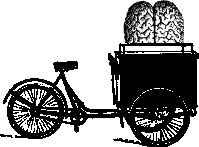
INFOMONGER: Everything. Everywhere. All the time.
And from...
INFOMONGER: Nesting participial phrases conveying vendor messages in radio plugs since the Night of the Watergate Break-in!
INFOMONGER: Everything. Everywhere. All the time.
And from...
29 August 2006
The joys of hardcore sf
"All the inner planets are eggs," he continued, flattening Drea's interjection like a Hummer ironing out a motorbike.
— Fantasy & Science Fiction, Oct/Nov 2006, 12.
20 August 2006
Two-step
In the linear life we lead, as opposed to the multivalent life we dream and remember, whenever you take a step in the wrong direction, you have to take two more just to stay in the same place.
17 August 2006
Grief
Grief turns out to be a place none of us know until we reach it. We anticipate (we know) that someone close to us could die, but we do not look beyond the few days or weeks that immediately follow such an imagined death. We misconstrue the nature of even those few days or weeks. W e might expect if the death is sudden to feel shock. We do not expect the shock to be obliterative, dislocating to both body and mind. We might expect that we will be prostrate, inconsolable, crazy with loss. We do not expect to be literally crazy, cool customers who believe that their husband is about to return and need his shoes. In the version of grief we imagine, the model will be "healing." A certain forward movement will prevail. The worst days will be the earliest days. We imagine that the moment to most severely test us will be the funeral, after which this hypothetical healing will take place. When we anticipate the funeral we wonder about failing to "get through it," rise to the occasion, exhibit the "strength" that invariably gets mentioned as the correct response to death. We anticipate needing to steel ourselves for the moment: will I be able to greet people, will I be able to leave the scene, will I be able even to get dressed that day?We have no way of knowing that this will not be the issue. We have no way of knowing that the funeral itself will be anodyne, a kind of narcotic regression in which we are wrapped in the care of others and the gravity and meaning of the occasion. Nor can we know ahead of the fact (and here lies the heart of the difference between grief as we imagine it and grief as it is) the unending absence that follows, the void, the very opposite of meaning, the relentless succession of moments during which we will confront the experience of meaninglessness itself.
— Joan Didion, The Year of Magical Thinking, 188-189.
Subscribe to:
Posts (Atom)